

Ask ten people what “vertical” means in business and you’ll get ten slightly different answers. Some think it’s just a fancy word for industry. Others use it interchangeably with niche or market segment. That confusion causes real problems, especially when you’re filling out a loan application, pitching investors, or setting up ad targeting and the form asks you to pick a category that doesn’t quite fit. This guide breaks down what business vertical classification categories actually are, the major systems behind them, and how to pick the right one for your company.
Business vertical classification categories are standardized groupings that sort companies by the specific industry or market they serve, rather than by general business function. The three dominant systems are NAICS (used for U.S. government and regulatory purposes), SIC (an older system still referenced in legacy databases), and GICS (used by investors and financial analysts).
Key Takeaways
- A “vertical” is more specific than a sector or industry; it points to a defined market segment.
- NAICS is the modern U.S. government standard, replacing SIC in 1997.
- SIC codes are outdated but still show up in SEC filings and older commercial databases.
- GICS was built specifically for investment research, not government reporting.
- Companies can belong to more than one vertical, but should identify a primary one for benchmarking and targeting.
- Getting your classification wrong can affect loan eligibility, ad targeting accuracy, and investor comparisons.
What Is Business Vertical Classification?
Business vertical classification is the process of grouping a company according to the specific industry, market, or customer type it primarily serves. It’s a narrower, more precise way of describing a business than a general label like “technology” or “retail.”
The distinction matters because broad categories hide meaningful differences. A software company selling to hospitals faces different regulations, sales cycles, and buyer expectations than a software company selling to retail chains, even though both might get lumped into “technology” on a form. Vertical classification exists to capture that nuance.
Sector vs. Industry vs. Vertical vs. Niche
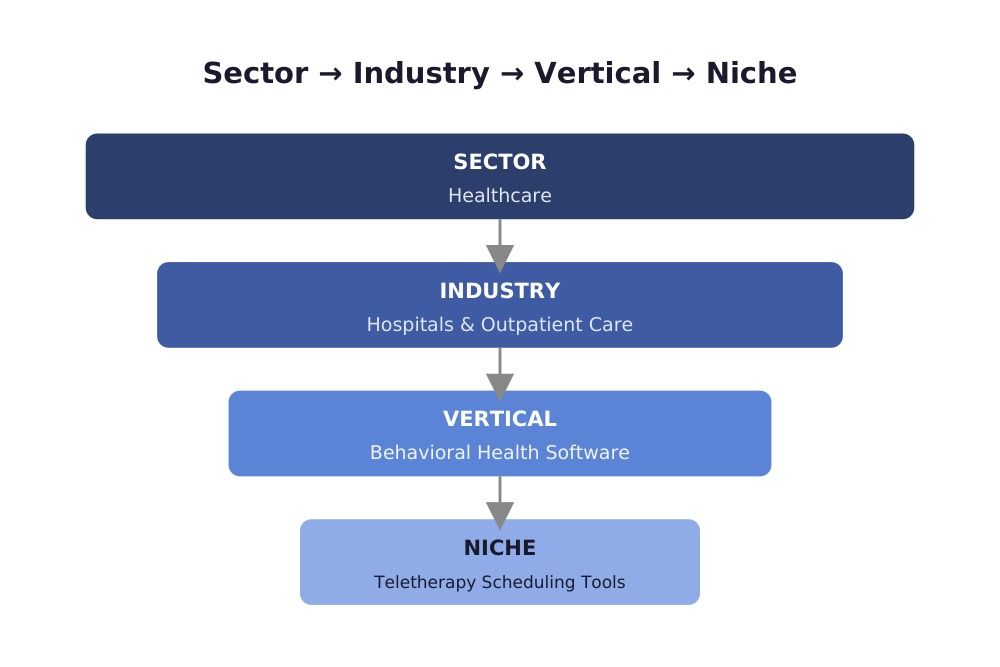
These four terms get used loosely, but they actually describe a hierarchy, moving from broad to narrow.
| Term | Scope | Example |
|---|---|---|
| Sector | Broadest grouping of economic activity | Healthcare |
| Industry | A defined segment within a sector | Hospitals and outpatient care |
| Vertical | A specific market focus within an industry | Behavioral health software |
| Niche | A narrow slice of a vertical | Teletherapy scheduling tools for solo therapists |
Understanding where you sit on this ladder helps you answer classification questions correctly instead of guessing, whether you’re filling out a government form or setting up a marketing campaign.
The Three Major Classification Frameworks
There’s no single global standard for business vertical classification. Instead, three frameworks dominate, and each was built for a different purpose.
NAICS (North American Industry Classification System)
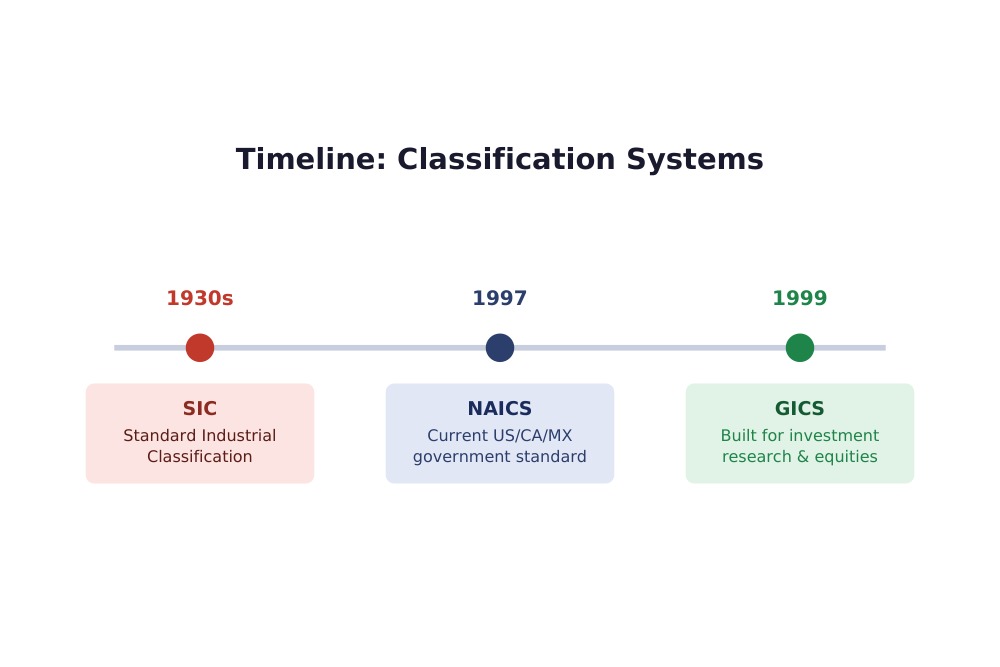
NAICS is the current standard used by U.S. federal statistical agencies, and it’s maintained jointly by agencies in the United States, Canada, and Mexico. It replaced the older SIC system in 1997 and gets revised roughly every five years to keep up with new industries. NAICS uses a numeric code structure, where each added digit narrows the classification further, from a two-digit sector code down to a six-digit national industry code. You can look up an official NAICS code for any business through the U.S. Census Bureau’s NAICS lookup tool.
NAICS codes matter for more than paperwork. They determine eligibility for certain government contracts, SBA loan programs, and industry benchmarking studies.
SIC (Standard Industrial Classification)
SIC dates back to the 1930s, making it the oldest formal classification system still in circulation. NAICS officially replaced it for federal reporting in 1997, but SIC never fully disappeared. Plenty of commercial databases, older financial systems, and even some SEC filings still reference SIC codes today, mostly because switching legacy systems over is expensive and slow.
GICS (Global Industry Classification Standard)
GICS was developed in 1999 by S&P Dow Jones Indices and MSCI, specifically for investment research rather than government reporting. It organizes the market into a clean hierarchy of sectors, industry groups, industries, and sub-industries, which lets portfolio managers zoom in or out depending on what they’re analyzing. If you’re researching publicly traded companies, GICS is generally the more useful framework, and filings that reference it can often be cross-checked against the SEC’s EDGAR database.
Comparing the Frameworks
| Framework | Built For | Established | Maintained By |
|---|---|---|---|
| NAICS | Government reporting, contracts, loans | 1997 | U.S. Census Bureau (with Canada, Mexico) |
| SIC | Legacy reporting, older databases | 1930s | Originally federal; now mostly legacy use |
| GICS | Investment research, portfolio analysis | 1999 | S&P Dow Jones Indices & MSCI |
Common Business Vertical Categories
While the numeric codes go into hundreds of specific classifications, most real-world businesses fall into a handful of widely recognized core verticals:
- Technology and software
- Healthcare and life sciences
- Financial services and insurance
- Retail and e-commerce
- Manufacturing and industrial
- Real estate and construction
- Education
- Hospitality and food service
- Transportation and logistics
- Energy and utilities
Each of these breaks into more specific sub-verticals. Healthcare, for example, splits into acute care, long-term care, behavioral health, pharmaceutical distribution, and medical devices, each with its own buyer expectations, compliance needs, and sales cycle.
Vertical Market vs. Horizontal Market
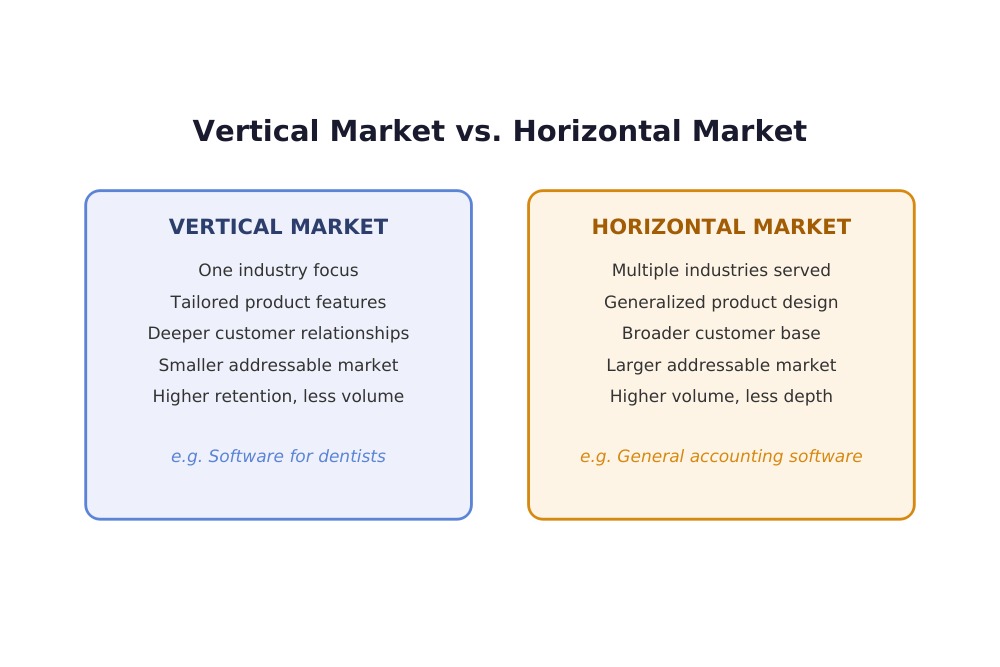
This distinction comes up constantly in SaaS and B2B strategy discussions. A vertical market focuses on one specific industry with tailored products, deeper relationships, and higher expertise, but a narrower total customer pool. A horizontal market serves many industries with a more generalized product, which usually means higher potential volume but less depth per customer. Neither approach is inherently better; the right choice depends on your product, resources, and growth strategy.
How to Classify Your Own Business
- Identify your primary revenue source. If more than one activity generates revenue, classify based on whichever brings in the majority.
- Look up the closest match in the NAICS directory for U.S. regulatory and reporting purposes.
- Check whether your industry has an emerging vertical classification, especially in fast-moving spaces like climate tech or AI, where formal codes sometimes lag behind the market.
- Reassess periodically. A business that pivots its main product or customer base should update its classification rather than sticking with an outdated one.
- Keep a secondary classification in mind if you genuinely serve two distinct markets, but avoid trying to claim five different verticals at once.
Common Mistakes in Vertical Classification
- Confusing sector, industry, and vertical. Using them interchangeably leads to inaccurate benchmarking and targeting.
- Ignoring hybrid verticals. Some companies genuinely straddle two markets and shouldn’t be forced into a single box.
- Sticking with outdated classification. A pivot in product or customer base should trigger a reclassification, not get ignored.
- Relying only on SIC codes. They’re useful for historical comparisons, but current analysis and reporting should lean on NAICS or GICS.
- Treating classification as a one-time task. Markets shift, and a vertical that fit two years ago might not fit now.
Expert Tip
If you’re applying for an SBA loan, a government contract, or an investor deck, don’t just guess your NAICS code from memory. A close-but-wrong code can cause delays or even disqualify an application, since eligibility for many programs is tied directly to the specific code on file. It takes two minutes to verify against the official Census Bureau lookup, and that small check can save weeks of back-and-forth later.
Why Correct Classification Matters
Getting your vertical classification right affects more than paperwork. Investors benchmark your growth rate, margins, and customer acquisition costs against companies in the same vertical, so a mismatch can make your numbers look better or worse than they really are. Marketers rely on accurate classification for ad targeting and account-based marketing lists. Lenders and government programs often set eligibility rules around specific codes. In every one of these cases, an imprecise or outdated classification quietly works against you.
Frequently Asked Questions
What is the difference between NAICS and SIC?
NAICS is the current U.S. government standard, adopted in 1997 and updated periodically. SIC is the older system it replaced, still referenced in some legacy databases and financial filings.
Can a business belong to more than one vertical?
Yes. Many companies operate across more than one vertical, especially as they scale, but it’s best to identify one primary vertical based on where most of the revenue comes from.
Where do I find my official NAICS code?
You can search for it directly through the U.S. Census Bureau’s NAICS lookup tool using your business activity or keywords.
Is GICS the same as NAICS?
No. GICS was built for investment research and portfolio analysis, while NAICS is the U.S. government’s standard for statistical and regulatory reporting.
Why does my NAICS code matter for a small business loan?
Some SBA programs and government contracts have eligibility rules tied to specific NAICS codes, so an inaccurate code can affect whether you qualify.
What’s the difference between a vertical and a niche?
A vertical is a defined market segment within an industry. A niche is a narrower slice within that vertical, often defined by a very specific customer type or problem.
Do emerging industries like AI or climate tech have official classification codes?
Not always. Fast-moving sectors sometimes grow faster than formal classification systems can keep up, so businesses in these spaces may not find a perfect existing code yet.
Should I update my business’s classification if I pivot my product?
Yes. Classification should reflect your current primary business activity, not the one you started with.
Final Thoughts
Business vertical classification categories aren’t just bureaucratic labels. They shape how investors evaluate you, how lenders assess your eligibility, and how accurately marketers can reach the right audience on your behalf. Taking a few minutes to classify your business correctly, and revisiting that classification as your company evolves, pays off well beyond the paperwork it’s attached to.